10 Reasons Engineers on Jardiance Are Quietly Adding 12mg Astaxanthin
Why a 67-year-old engineer's eGFR kept drifting through a year of metformin, lisinopril, and Jardiance — and the single carotenoid that finally bent the chart line back up.
Third-Party Tested
15,859+ Reviews
90-Day Guarantee
You did everything the cardiologist asked. Metformin twice a day. Lisinopril for six years. The SGLT2 inhibitor he added last year because the kidney numbers had started drifting. Your wife put you on a 50-gram protein cap. You cut sodium until restaurants stopped being restaurants. Your eGFR still walked from 78 to 54 in fourteen months.
You went looking. You bought four hundred dollars' worth of kidney pills off Amazon. None of them moved the chart line one degree. Then four weekends in your basement, a PubMed login, and one Yang 2015 paper later — you found what the prescription was missing.
This page walks through what an engineer reading kidney papers at 6 AM kept finding: one small carotenoid that works on a part of the filter cell your prescription never reaches. Astaxanthin. There's a bit of science below — but each reason starts with the picture before the jargon. Skip the parens if you don't want them; they're there for the readers who do.
1
You Did the Work. The eGFR Drifted Anyway.
Fourteen months on the prescription. Sodium cut. Protein capped. And the chart line still moved from 78 down to 54. That isn't a discipline problem. Think of your kidneys like coffee filters with a million tiny holes. The prescription slows what gets dumped onto the filter — it doesn't repair the holes that are clogging. (The science calls this the difference between load reduction and glomerular cell protection.)
Think of it this way:turning down the faucet doesn't unclog the filter. It just gives the clog more time to set.
2
The Prescription Works at the Intake. The Damage Is on the Filter Itself.
Your kidney is a water-treatment plant with two zones. The prescription installs a meter on the intake line — it tells the plant to send less sugar into the filter. But your filter screens are degrading at the cellular wall, where the prescription never goes. The 2015 trial class was designed for the intake. It was never built to protect the screen material itself. (Researchers call this upstream load reduction vs. downstream cellular oxidative stress.)
Translation:the prescription does good work at the intake. It was never engineered to protect the filter screens where the holes are actually clogging.
Swapping bottles won't fix the trend. The dandelion-and-uva-ursi teas on Amazon move water around — not the filter material itself. "Renal support" blends mostly stack potassium and magnesium, which a Stage 3 patient is already trying to dial back. Hydrogen tablets that water-dissolve in your bottle never reach the inside of the filter cell. The bottle changes. The floor doesn't.
The bottom line:you didn't pick the wrong bottle. The whole shelf works one floor above the part of the filter cell the eGFR is actually stuck on.
4
"Just Keep Doing What You're Doing" Is a Hope, Not a Mechanism
Your cardiologist meant well when he said monitor and keep walking. But the signal that tells your filter cells to deploy their own antioxidant defenses fades with age, no matter how clean the diet. You can drink three liters a day and cut your protein to fifty grams. If the cell's master switch isn't getting the signal, the chart line keeps drifting. (Researchers call the master switch Nrf2.)
Worth noting:"come back in three months and we'll watch the trend" isn't a mechanism. It's a hope that the filter will catch up on its own.
5
One Small Carotenoid That Can Reach the Filter Cell
Your cells have walls made of fat. Most antioxidants bounce off the outside and never get inside. Astaxanthin is small enough and oily enough to sit inside the wall itself — including the wall of the filter cell. Once it's there, it helps the cell's master switch wake back up, and it protects the screen material the filter depends on. One molecule. Two jobs at the same place the prescription can't reach. (The science calls these cell-membrane spanning + Nrf2 antioxidant support.)
Why it matters:getting inside the wall is what lets one small carotenoid touch a switch four hundred dollars of Amazon kidney pills couldn't.
A 2025 Meta-Analysis Pooled the Kidney Markers Across Trials
A 2025 review pooled the human astaxanthin trials and found oxidative-stress markers dropped consistently and the inflammation markers tracked down with them. The animal renoprotection record stacks several studies behind it — the diabetic-nephropathy mouse work goes back to 2004. (Laurindo 2025 on PubMed for the meta-analysis; Naito 2004 for the original diabetic-kidney mouse paper.)
By the numbers:twenty-plus years of kidney mechanism work behind one small carotenoid. The 2025 meta-analysis brings it forward.
7
Most Brands Sell a Third of the Studied Dose
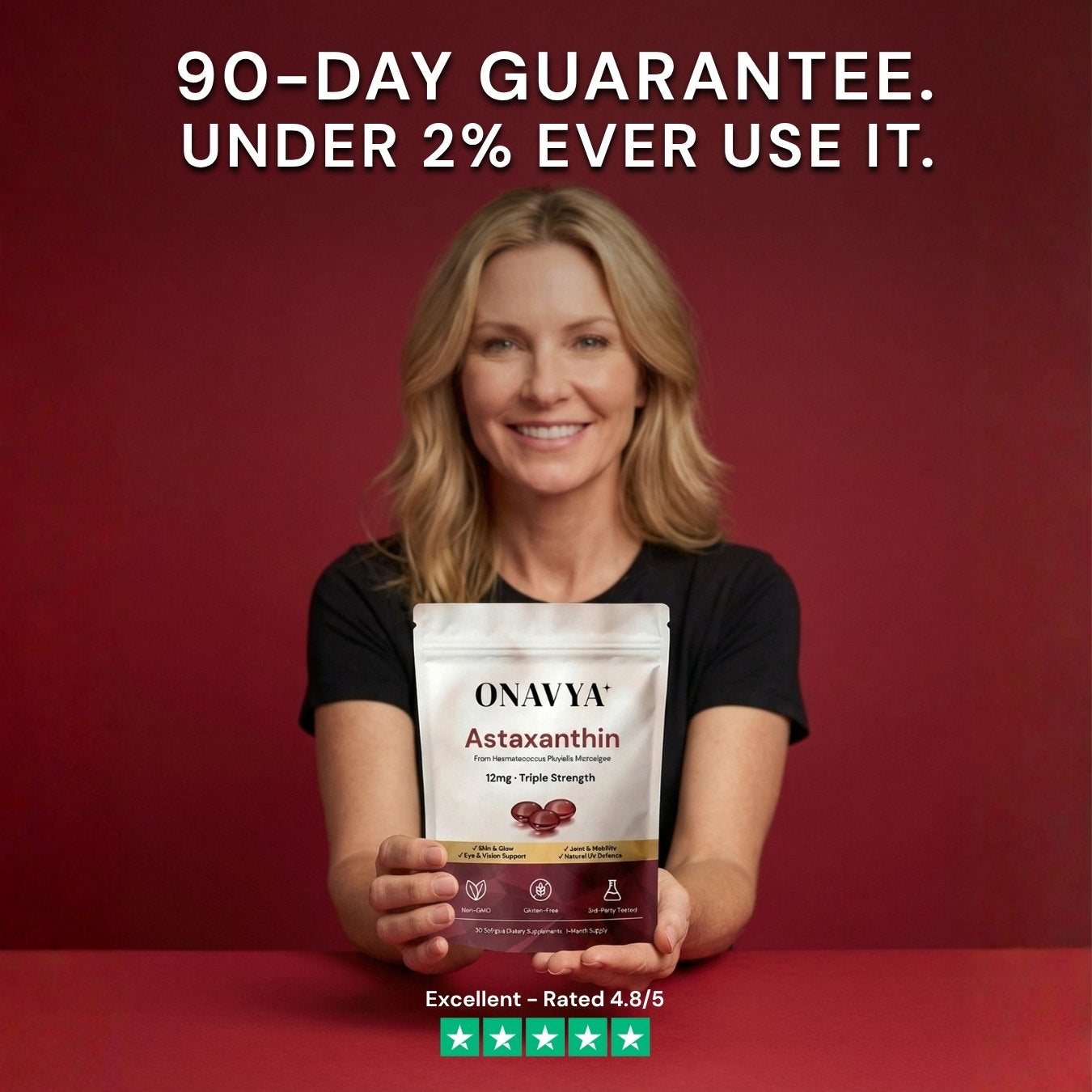
The animal kidney studies used a 12-milligram-equivalent dose. Most astaxanthin softgels on the shelf sell 4 to 6mg per capsule — barely a third of the dose researchers actually studied. Onavya delivers the full 12mg in a single softgel, sourced from a microalgae called Haematococcus pluvialis and paired with oil so your body actually absorbs it. No filler. No 4mg shortcut.
Important:two-thirds of the astaxanthin on the market is below the dose the kidney researchers used.
8
Potassium-Free, Phosphorus-Free — Made for a Renal Diet
After a year on the renal-diet line, the last thing you need is a supplement that sneaks potassium or phosphorus back into your day. Onavya is a single-ingredient softgel: astaxanthin, microalgae oil, and the softgel shell. No potassium load. No phosphate filler. No proprietary blend hiding fifteen ingredients you didn't sign up for. Third-party assay on every batch.
In short:one ingredient. One number on the label. Nothing your nephrologist will frown at on the bottle.
9
One Softgel With Breakfast. No New Side Effect to Track.
This isn't another prescription you have to log. You take one small softgel with your morning coffee and walk away. No new drug interaction column on the spreadsheet. Across the human astaxanthin trials, no serious side effects were reported at doses up to 20mg a day. The most common note is a slightly reddish tint in stool — a harmless trait of carotenoids (the same family that colors carrots orange).
Math check:four hundred dollars on Amazon kidney supplements that didn't move the chart line, for one softgel that costs less than your monthly prescription co-pay.
10
Ninety Days to Test It at Your Next Labs. Zero Risk.
Take it for ninety days — the window that lines up with your next kidney panel. Let your nephrologist read the eGFR. If the chart line hasn't moved — or the trend isn't bending the right way — full refund, no questions, no fine print. The risk lives on our side, not on the next column of your fourteen-year spreadsheet.
The deal:ninety days of honest testing against your own labs. Full refund if the numbers don't move. The risk lives on our side.
Not All Astaxanthin Is Created Equal
Most astaxanthin supplements deliver only 4–6mg per softgel — barely a third of the dose the kidney researchers actually used. For one small carotenoid to reach the part of the filter cell where the master switch lives, you need the full 12mg, sourced from Haematococcus pluvialis microalgae and paired with oil so it absorbs.
12mgClinical Dose
70+Human Studies
90 DaysMoney-Back
Your Kidneys Have Been Carrying You. Time to Return the Favor.
Give your kidney panel 90 days on Onavya — the window that lines up with your next eGFR draw, and the duration of the money-back guarantee. If your next chart line and the trend aren't both quietly bending by then, full refund, no questions, no fine print.
Third-Party Tested · 12mg Clinical Dose · Free US Shipping over $75
*These statements have not been evaluated by the FDA. This product is not intended to diagnose, treat, cure, or prevent any disease. Cited from Laurindo et al., Pharmaceuticals (Basel) 2025;18:1097 (PMC12389351) and Naito et al., BioFactors 2004;20(1):49-59. Individual results vary. Consult your healthcare provider before starting any new supplement, especially if you are taking medications for diabetes, blood pressure, or kidney disease.